Friday, February 2, 2007

The Devil Wears Prada

Overall I enjoyed this movie much more than I thought I would. Incredibly low expectations do allow for the occasional pleasant surprise. Perhaps it was because it was just a little bit less bland than your average cookie-cutter HW film. The characters seemed to have that something extra to draw you in and the Academy agreed by giving Meryl Streep a nod for how effectively she dripped with her cold and calculating corporate disdain. Another tribute to low standards?

What is more interesting is how women are portrayed in this film. Stereotypical in all respects. Meryl Streep, as the head of Runway magazine, depicts the quintessential ruthless woman that loves the job more than her family and ends up in another divorce. In the one moment when she shoes remorse and emotion in the film, after learning her husband wants to leave her, she is still solely concerned with how she will be perceived in the tabloids. She then follows by selling out her friend and art director to keep her job. She tries to convince Anne Hathaway's character (actual name not important) that you have to be evil to stay ahead and despite lack of soul, "everyone wants to be us." Anne doesn't fall for it and the most character progression we get out of Steep's character is an ambiguous smirk and semi-positive letter of recommendation for Hathaway. I guess we are supposed to be happy that the badly dressed smart girl doesn't lose her soul and wind up in fashion, but really who cared about her to begin with?

More interesting was Streep's first assistant, Emily, played by Emily Blunt. For some reason that girl drew me in. Her part was well acted and as the "Devil's" protege, much more interesting. I don't know how her character affects the stereotype of women, but at least it wasn't naive and typical. The film does make the point that if Streep's character was a man her behaviour would be laudable and strong, but as a women she is the "Devil." Let's have some strong women who can do both, be successful in business and have a soul. Or would that be to detrimental to the strength of patriarchy?

Tuesday, November 21, 2006

Saving Face

This article has very good commentary about Alice Wu's Saving Face . Kristi Mitsuda, although a bit harsh, makes valid and compelling points and the rebuttal to her article is equally interesting and leans more towards my sentiments. In the drab sea of crappy this-is-my-grad-thesis lesbian films it was nice to have a plucky romantic comedy of our own. Although I'm not Asian, I did appreciate the Asian culture and although it did seem stereotypical and cliche-for-a-laugh, I enjoyed the characters and the story. I disagree with Mitsuda, skimming the surface is better than nothing at all.

Primarily, I respect how this film was made despite the shortcomings it may have. A lesbian computer engineer with a masters from Stanford works for Microsoft for 6 years and then suddenly decides she is going to be a filmmaker. She takes her average script to NY and gives herself a 5 year time limit to make it or break it. In 2001, her script for Saving Face wins the CAPE (Coalition of Asian Pacifics in Entertainment) screenwriting award and shortly thereafter she gets Will Smith's production company to back her and she is directing her first film ever. This is the story that keeps a million kiddies trying to break into the business every year. Is it really all about luck?

Monday, November 20, 2006

Writing

I think a good film is a balancing act of giving people what they expect to see in a in a way they don't expect. Is it possible to be innovative when everything has been done? Yes I think so, but you can't just chuck everything out of the window, and you can't just reverse convention and expect that to be interesting. There must be a way to transcend convention and break stereotypes. I have to figure out how to give into convention with out selling out, satisfying people with good film without being banal. The only way to do this is to practice, practice, practice!

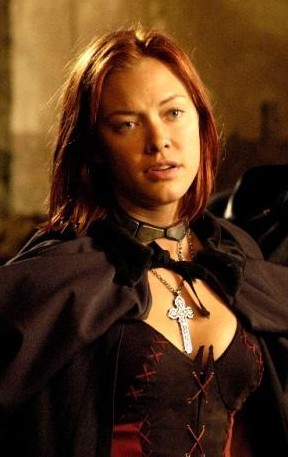
BloodRayne

Oh what it could have been...
Finally an action film with big budget queer women stars (Kristanna Loken from Terminator and Michelle Rodriguez from Girlfight, Resident Evil etc.) written by the occasionally talented out lesbian Guinevere Turner. Sounds like the opportunity for smashing conventions and stereotypes of traditional women action films. It could have been the perfect opportunity to thoroughly abolish the ides of Yvonne Tasker in which the tension caused by the presence of a woman hero at the center of the action movie must be allayed by placing her in acceptable roles such as a mother or wife, with an overt sexuality making her available to a heterosexual male audience or through the use of comedy. Here we have unconventional women that reflect the ideas of Mark O'Day's article "Action Babe Cinema" in working toward the dissemination of binary definitions of gender. I was expecting at least a little bit of fluidity in sexual identification and more gray area in terms of the conventional stereotypes of action women cinema. Something that could take a little action film based on, what else but a video game, and use it to create some waves that could ripple out and cause a little bit of change in the way strong women are represented onscreen.

Oh god, that is so far from what we got in this movie that my glimmer of hope for something redeemable has been completely and utterly obliterated from every angle. The writing and plot were abysmal, banal and played on every well established convention known to man. Guinevere Turner took absolutely zero risks and may as well been a 17 year-old boy living our his violent video game, hot woman hetero-sex fantasy. Oh wait, that was the director. Even when Turner did include brief glimpse of slight deviation from heteronormativity in Rayne's close relationship with her carnival "sister" and in the scene when she kills a vampire by seducing her and biting her neck, she immediately fell right back on convention by killing her friend to support the traditional rape/revenge plot that has given both action men and women an nonthreatening means of supporting and legitimizing their use of violence for decades. She also wrote an almost completely unmotivated and rather rough sex scene between Rayne and her untrusting, almost friend-for-5-minutes head of the Vampire hunters, Sebastian (played by Legally Blonde's ultra-normal Matt Davis).

Everything else was exceptionally abysmal. It was a random series of neurotic, barely connected, poorly choreographed "fight scenes." The one memorable moment came directly because of Kristanna Loken's charisma in the scene when she avoids multiple pitfalls and hangs from the ceiling to escape death by water as she recovers the eye of the most powerful vampire that ever lived. The politics behind the vampires and the humans in the Brimstone society were vague and convoluted, despite their possibility to bring a more real world element a la Interview with the Vampire to the plot.

I'd really like to give Turner the benefit of the doubt and say it was all Uwe Boll and his reputation for being the worst film director on the planet, but I honestly don't think there was much hope for it from the beginning. Boll's costumes, props, sets and lighting all look like they are meant to go straight to DVD and are bad even for a B movie. His characters deliver their lines like they are confused ventriloquist dummies, the choreography of the fight scenes is awkward and the camera angles are disorienting. When making a rubutle against criticism of his film in the DVD extras he argues that his films are just as good as other video game films because the special effects are the same quality as the ones used in Resident Evil. I don't know what he is smoking to think that, but someone should tell him that special effects do not a movie make. He provides the audience with no way to connect to or identify with the characters and in this case, I don't want to. Turner's conventional rape/revenge plot is presumptuous and assuming without any novelty or explanation and the Rayne character is just as messed up in the head as the plot and character development.

In the end it was hot women doing awkward things in awkward ways. I won't even talk about Michelle Rodriguez's lack of motivation and misconstrued accent. Even the chemistry between her and Loken was sterile onscreen, like the chemistry between all the characters. I think I'll stick to the video and the wonders of my imagination.

Sunday, November 19, 2006

Silent Hill

I recently watched Silent Hill, intrigued at the thought of having a women hero who holds her own in a monstrous world, accompanied by a super tough we-are-going-to-hint-she's-a-lesbian cop because she has short hair, but never actually say it. But I think dyke cops are acceptable stereotypes now, like the fashion savvy queer-eye-for-the-straight-guy, gay man. They are fine as long as they are helping normal people out, but don't put them in the role of wife or mother or all hell will break loose. Speaking of, I was hoping this movie would be a little different with two women as the leads, but unfortunately, it was predictable to a T. Originally in the video game, the character was a man, searching for his lost daughter in a creepy haunted town. When writing the script the creators of the movie decided to change character to a woman because they felt that it just made more sense that way. Meaning that the character as written conformed to the stereotype of woman as a mother and it was believable to have a hysterical woman try to save her child, but less believable for it to be a man. I think I would have preferred a man in this lead, just to, I don’t know, break from conformity. Scary, I know.

So, what we are left with is the same old hysterical mother trying to save daughter from nightmarish monsters and the pseudo lesbian cop kicking ass and protecting or saving the mom at any chance she gets. Conforming with conventions (the precedent set by the Alien movies), the lesbian, who does not accept the normal role in society of mother/wife, must die, in this case sacrificing herself so the real mother/daughter may be reunited. *In essence, as in past action movies, the tension caused by the presence of a woman hero at the center of the action movie must be allayed by placing her in acceptable roles such as a mother or wife (evident in Aliens with Sigourney Weaver being introduced as a mother and then adopting an abandoned child), with an overt sexuality making her available to a heterosexual male audience (Tomb Raider) or through the use of comedy (not really applicable in Silent Hill). More on this to come…


On a side note, why are lesbians, or tough “dyke” ladies in films always cast by the most conventionally beautiful women (at least in their headshot)? Is it because Hollywood lesbians must conform to get jobs or is it more acceptable for straight women to play the lesbian character so as to cause the least amount of tension amongst the straight audience through deviation from the norm?

This mildly entertaining flick didn’t really do anything out of the ordinary and overshadowed its great sets and costumes with an overuse of computer generated effects. A break from convention in anyway would have made it memorable, but nonetheless I’d likely see the sequel when it makes it to DVD.

*Add quotes from my reading to strengthen these points.